
Light, crisp, sweet and chewy all at the same time, it is no wonder that these symbols of dainty indulgence have become the pinnacle of French pâtisserie.
However, for quite a while they too have been my nemesis: the one item that time and time again I’ve failed to perfect. And so in a dedicated attempt to cross these delicate mouthfuls off of my baking bucket list, I have spent a concerted amount of time researching, testing, trialling, erring and finally perfecting them.
This has paid off. The first time I perfected macarons, as surprised as I was I accidentally won a nationwide baking competition. Yes, my macarons won me Tesco’s Star Baker.
Overwhelmed would be an understatement. I was absolutely gobsmacked! And so, it only seemed fitting to share a blog post dedicated to decoding and revealing the secrets of the most cherished and revered item in any pâtisserie chefs repertoire.
Macarons, Reassuringly Intricate?
What my turbulent kitchen adventures with these delicate cookies have taught me is that they are reassuringly intricate. If you pop into any bakery or pâtisserie looking to pick up these beauties, what will hit you first is their price; they certainly are not the cheapest item on the shelf.
Perfecting a French macaron will take both reels of patience and of course practice – and a few little tricks of the trade! All of which I feel justify their price.
Tips and Tricks
Before attempting any macaron recipe, I would highly recommend investing in a couple silicon baking mats and a sugar thermometer. These will also prove invaluable for many other recipes, but for macarons, I would say indispensable.
Without these godsends, removing your macarons from baking paper will tumble into a crumbled, cracked and down-right disheartening type of chaos.
Another must-follow-tip is that you need to ensure that all your equipment is bone dry and perfectly clean. This goes for any meringue recipe. In the same way, the smallest amount of egg yolk can interfere with the meringue on catastrophic scales. It stops the egg whites for forming the thick structural foam that will give you macarons the crisp shell and soft interior.
My Award Winning Recipe
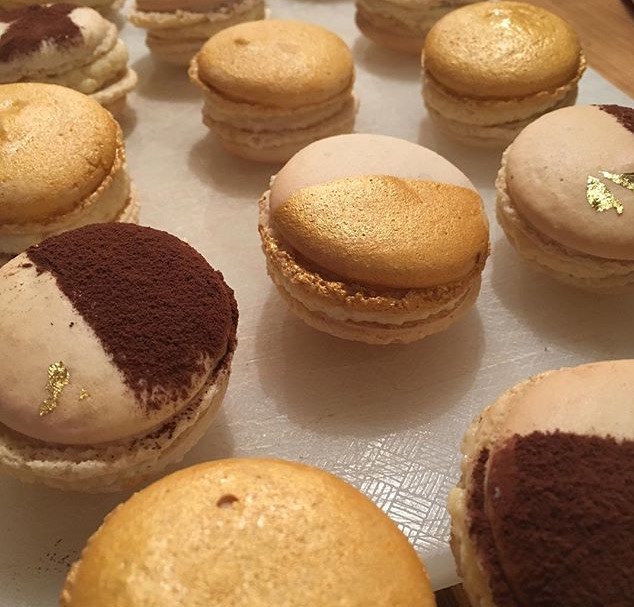
And so, without further ado, here they are, my award winning and pride saving coffee macarons:
Makes c. 40 3cm Macarons
INGREDIENTS
For the Macarons
200g Ground Almonds
200g Icing Sugar
75ml Water
200g Caster Sugar
2 lots of 80g Egg Whites
1-2 drops of Coffee Extract*
*Either in flavouring or mix up 1/2 tsp of instant coffee in 2tbs of warm water
For the Coffee Cream Filling
250g Softened Butter
140g Icing Sugar
160g Ground Almonds
1-2 drops of Coffee Extract*
METHOD
For the Macarons:
Pre-heat your oven to 150°C.
Begin by blitzing the ground almonds and icing sugar in a food processor to form a tant pour tant. This is a key step as it ensures a smooth batter which will deliver a smooth macaron shell. Once processed, sift this mixture and set aside.
In a heavy-bottomed saucepan, bring the water and caster sugar to a boil – stirring until all the sugar is dissolved, once past this point refrain from stirring. Using a thermometer, make sure that the syrup does not exceed 115°C. After reaching this temperature take the syrup off the heat and allow to cool slightly – you don’t want it cooking the egg whites!
Next, beat one lot of your egg whites to soft peaks. Then increase the whisks speed and gently pour in the syrup – in one thin continual stream. Once added, continue to beat your meringue mixture for a further 10 minutes.
Whilst mixing, combine your processed ground almond and icing sugar mix with the remaining un-whisked egg whites. Using a spatula, combine until you are left with a smooth paste. Add in your coffee extract now.
After this and using a very flexible spatula, incorporate around 1/3 of your meringue mix with your paste to loosen the batter. This will take work and be a bit time consuming – but it is all worth it I promise! After this is completely combined, add in the remaining meringue mixture, this time around it should be a little easier. Be careful not to knock all the air out – a folding technique works best!
Once you are satisfied both mixtures are mixed together and there are no lumps, so you are left with a smooth consistent batter, fill a piping bag that is fitted with a round nozzle – 8mm works best for these.
Place your baking mats onto a baking tray and under these either draw out 3cm in diameter circles – some baking mats come with macaron sizes already on if you’re aiming for real perfection.
Carefully, pipe small, regular and well-spaced circles. Swirling the piping bag and lifting sharply for a seamless top.
Once piped, lightly tap your baking trays and leave your macarons to form a crust – this should take around 30 minutes. This resting time is critical and will ensure your macarons have their signature ‘foot.’
Then bake for 15 minutes and remove. Wait for your macarons to completely cool before removing from the baking mats.
For the Coffee Cream Filling:
Using an electric mixer, mix the softened butter on high speed until it is very soft and pale. Then, slowing the mix speed down, add sifted icing sugar 1tbsp at a time this ensure a smooth even icing. once combined add your coffee extract and ground almonds.
Using a piping bag, fill one half of the macaron shell and assemble using the other half.
Once assembled, decorate using anything you like! I found cocoa, coffee beans and gold glint worked exceptionally well! But this is up to you – get creative! I’d love to see what you come up with!
 A little Tasty