


Being a real foodie and working in marketing it was only a matter of time before my two mistresses met!
I am a real admirer of all the work of Big Fish a brand, design and marketing agency in London. Most of their work, from what I have seen, focuses mainly on boutique and artisanal food brands and they have worked on projects for the likes of Chesil Smokery, Yeo Valley, Belvoir, Clipper, Gu and many more.
One project that they have worked on that really struck a chord with me – being a countryside food lover with an admiration for all things design – was the work they have produced for Dorset Cereals.
Dorset Cereals are one national brand that notoriously, and somewhat controversially, strive to avoid television advertising. A brief including such an aim like this offers creatives absolutely fabulous constraints:
Cancelling out all above the line promotion means that all the creative, branding and marketing brains have to completely pull together in order to optimise any assets that are available. The little things really do start to account for a lot. A stripped back organic and almost raw approach is needed, which is very fitting with the whole brand persona that Dorset Cereals portrays for itself.
When dealing with food products and peeling them back to basics, your packaging really does become your best media.
Branding, etymologically, recognises this. In the traditional sense a brand is an identifying mark burned on livestock, criminals and slaves with a branding iron. With the rise of packaged goods in the 19th century, producers began to mark their produce to distinguish their origin.
Coca-Cola is probably the leading example of this realisation of the importance of a branded mark in the late 1880s: When the company was starting out they certainly were not alone. There were many competing soda producers out there. Coca-Cola recognised that before they could get a customer to reach for a Coke and to open happiness or taste that feeling, they needed to be sure that their customer could actually distinguish a Coke from all the other caramel-colored beverages out there. And so the Coca-Cola brand and logo, that is so worshipped today, was born
In the first sense of the word, then, a brand is simply the non-generic name for a mark that tells us the source of the product.
Branded packaging, therefore, is indeed itself a form of advertising: Shop shelf advertising. Your products outer shell needs to distinguish and qualify itself from its many numerous competing neighbours.
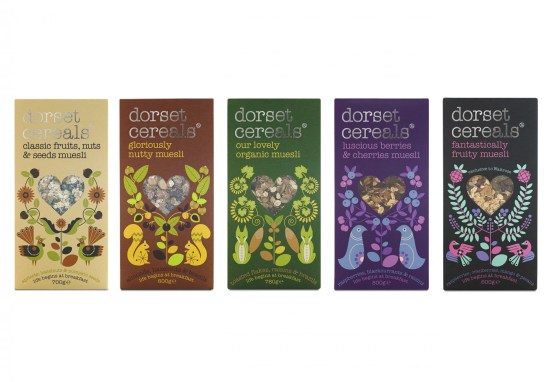 Photo Source: http://www.bigfish.co.uk/blog/portfolio/-cereals-refresh/
Dorset Cereals: Serial Packvertisers!
Dorset Cereals strapline – or more appropriately their mission statement – is ‘honest, tasty and real.’ Consequently, the very act of advertising itself would have been inherently wrong; adverts are not honest nor real and I cannot confirm them either to be tasty!
But how do you raise awareness and engage with people to encourage them to trial your product for themselves without blearing it out across the nation? Easy! packaging becomes your advert and shop front.
However, capturing all aspects of a product in one aesthetically pleasing, and mouthwatering outer shell definitely is a job easy said than done:
Designs need to shout – but not too loudly – Dorset Cereals certainly didn’t have anything to prove. They needed to be beautiful in themselves whilst accentuating the taste of the product inside. They seem to completely understand that their product is good, tasty and organic, why should they elevate this and promote it: It is its utter rawness that is its intrinsic appeal
Cleverly, the designers at Big Fish created packs that looked exactly how the cereals themselves tasted this meant that no precious advertising space was sacrificed to classifying the flavour. The flavour became central to the designs that stuck to the company’s branding like glue; honest, tasty and real. It wasn’t trying to be something it’s not, instead it is almost inside out; the insides are clearly displayed and celebrated on the outside.
Another cunning way that the Big Fish have ensured Dorset Cereals look both tasty and real is by adding an inventive cut out leaf feature in the box design. This cleverly opened a window into the cereal’s soul allowing consumers to see and pre-experience the product before buying.
The designers shrewdly added a shiny silver logo which really does jump out our magpie human nature and natural inclination towards all that is shiny – how many of you have wanted something just because of its shine – ladies I know I’m not alone here, and boys think back to the unbelievable value that you placed on your shiny Pokemon cards!
A final way in which it was ensured that Dorset Cereals would stand out and almost leap off the shelf into customers baskets and trolleys was the shape of the product. They made the boxes smaller and more stylish. Such unique cereal packaging gave this muesli an air of accomplishment when compared and contrasted with its peers on the shelf. They really did break the mould and separated themselves from mainstream cereals.
The product’s boxes were then beautifully and intricately illustrated with organic and happy compositions. This final touch ensured that the products packaging inherently appealed to their typical customer, who after extensive customer insight, it appears is sophisticated and has great taste and thus one who appreciates the importance of aesthetics.
In this case, Big Fish have delivered over and above. Dorset Cereal packaging is not only hugely effective shelf advertising but it really is very polished and works as a very stylish breakfast table centrepiece; Dorset Cereals have positioned themselves as the centrepiece of breakfast.
This success can not only be seen visually but fiscally too. When Big Fish began work with Dorset Cereals they were valued to be a £4 million company, nowadays they are a phenomenal £40+ million brand who continues to align its packaging, website, social channels, events and blog to evangelise its products.
Dorset Cereals these days could easily afford top end above the line advertising but it fundamentally goes against what the brand stands for. Instead, it is a brand thriving from being stripped back to basics and then reconstructed around its core values; Honesty, Reality and taste – both sensual and aesthetic.
The question however remains; has TV advertising robbed certain sectors of celebrating their fundamental unique assets and USPs?
In the food sector, I strongly believe that advertising needs to be reigned in and brought back to basics. The products should be left to speak for themselves – aside perhaps from some clever enhancements!
Big Fish you’re doing it right and I for one can’t wait to see what you do next!
 A little Tasty